Industrial cotton swabs, thanks to their dust-free, anti-static, and highly absorbent properties, and their ability to reach into
tiny crevices, are widely used in industrial settings such as precision manufacturing, cleaning and maintenance, and scientific
research and testing. Their core application areas and specific uses are as follows:
1.Electronics Manufacturing (Core Application Scenarios)
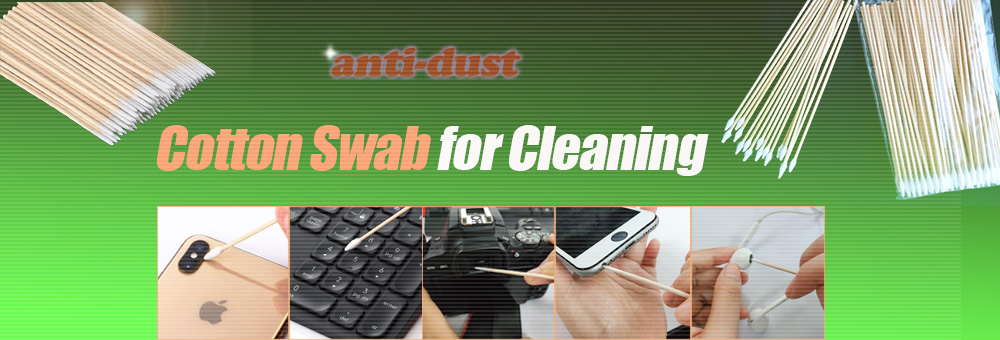
Cleaning the solder pads and pins of printed circuit boards (PCBs), removing residual flux, rosin, and solder dross after soldering to prevent short circuits or poor contact.
Wiping away dust, fingerprints, and oil stains from the surfaces of electronic components such as chips, capacitors, resistors, and connectors, especially suitable for
the assembly processes of consumer electronics such as mobile phones, computers, and tablets.
Cleaning the nozzles and suction tips of SMT placement machines and reflow soldering ovens to maintain equipment precision.
2.Precision Instruments and Optics Industry
Cleaning the lenses, prisms, and sensor surfaces of optical instruments such as microscopes, telescopes, camera modules, and laser rangefinders, using ultra-fine
microfiber industrial cotton swabs to avoid scratching the optical coatings.
Wiping the tiny crevices and components of precision instruments, such as watch movements, vernier calipers, and micrometers, to remove dust and lubricant residue.
3.Automotive Industry
Cleaning of automotive electronic components, such as in-car navigation screens, sensors (tire pressure sensors, camera sensors), and ECU circuit boards,
to remove surface impurities and ensure stable operation of electronic systems.
Pre-treatment before automotive painting: Wiping down tiny gaps and welding points on the car body to remove oil and dust, preventing bubbles and defects after painting.
During maintenance, cleaning carbon deposits and oil stains from engine fuel injectors and spark plugs, or cleaning the grilles and vents of the car's air conditioning system.
4. Medical Equipment Manufacturing and Repair
When assembling sterile medical equipment, use lint-free, sterile industrial cotton swabs to clean the precision parts of endoscope lenses, ultrasound probes, and surgical
instruments to prevent contaminant residue.
When repairing medical instruments (such as monitors and blood analyzers), wipe the sensors and circuit boards inside the equipment to ensure the accuracy of the
equipment's measurements.
5. Printing and Packaging Industry
Cleaning the print heads and nozzles of printing presses (such as inkjet printers and UV printing machines), removing ink residue to prevent nozzle clogging and ensure
clear print patterns.
Wiping the dies and plates of label printing machines and die-cutting machines to remove paper scraps and ink stains, improving the yield of packaging products.
6. Aerospace and Defense Industries
This application involves cleaning sensitive avionics equipment (such as radar and navigation systems), precision components of engines, and the surfaces of sensors
in missiles and satellites. This scenario requires the use of ultra-high purity, anti-static industrial cotton swabs to prevent impurities from affecting equipment performance.
7. Laboratory and Scientific Testing
Laboratory sampling: Used to collect small amounts of reagents or samples for microbial testing, chemical analysis, sample smearing, or transfer.
Cleaning small crevices of laboratory glassware, such as test tube openings, petri dish edges, and pipette tips, or wiping components of laboratory instruments
(such as chromatographs and mass spectrometers).
8. New Energy Industry
Cleaning dust and electrolyte residue from the electrode sheets and separators of clean lithium-ion batteries to improve battery safety and lifespan.
Wiping down the solar cells and junction boxes of photovoltaic modules to remove dust and oil stains, ensuring efficient solar power generation.





 34100202000386
Some pictures and words come from the Internet. If you infringe, please contact our website to delete them.
34100202000386
Some pictures and words come from the Internet. If you infringe, please contact our website to delete them.