What are the main uses of cotton swabs for pets?
2026/1/21 20:44:39Browse:874
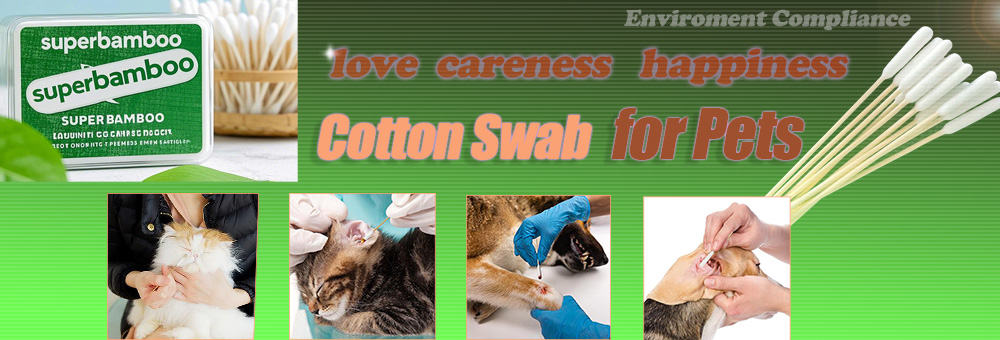
The uses of cotton swabs for pets are as below:
1. Ear Canal Cleaning and Care (Core Scenario)
Regularly clean earwax and secretions from the outer ear canals of cats and dogs to prevent ear mite infestation and ear canal inflammation.
This is especially suitable for breeds with floppy ears (such as Bichon Frise and Poodles) and folded-ear cats, which are prone to dampness and blockage in the ear canals.
After applying pet-specific ear drops, gently wipe away excess medication from the outer ear canal with a cotton swab to aid absorption; during ear mite treatment,
a specialized cleaning solution can be used to clean the black secretions inside the ear canal.
Note: Do not insert the cotton swab deep into the ear canal to avoid puncturing the eardrum.
2. Eye Cleaning and Tear Stain Care
Wipe away eye discharge and tear stains from your pet's eyes. This is suitable for flat-faced cats (such as Persian cats) and long-haired dogs
(such as Samoyeds and Golden Retrievers) and other breeds prone to tear stains. It can be used in conjunction with pet-specific tear stain remover.
If a small amount of dust, hair, or other foreign objects get into your pet's eyes, gently remove the foreign object with a sterile saline cotton swab
to prevent your pet from scratching its eyes and causing further injury.
3. Oral and Facial Local Cleaning
Clean food residue and saliva stains from the corners of your pet's mouth and the base of their whiskers to prevent bacterial growth and odor.
For treating feline acne ("black chin"): Dip a cotton pad in a gentle, pet-specific cleaning solution and gently wipe away blackheads and oil buildup
from the hair follicles on the chin, avoiding forceful squeezing.
Assists in cleaning food residue from between your pet's teeth (in conjunction with pet dental gel), suitable for young or elderly pets who resist brushing.
4 - Paw and Interdigital Cleaning & Care
After pets come back from outdoors, use the swabs to wipe off sand, dust, snowmelt or other dirt trapped in the crevices of their paw pads,
so as to prevent interdigital dermatitis, especially in rainy seasons or humid environments.
After trimming your pet’s nails, use the swabs to clean slight bloodstains around the nail area (e.g., when you accidentally cut the quick),
or apply styptic powder with the swabs to assist in hemostasis.
Skin and Wound Care
When your pet suffers from mild fungal infections (such as ringworm) or eczema on the skin, dip the swabs into specialized ointment and
spot-apply it to the affected area. This avoids direct contact of the lesion with your hands and prevents the pet from licking the ointment.
Clean the dirt around the wounds of minor abrasions and scratches on your pet, and disinfect the area with povidone-iodine swabs
(the pet-specific non-irritating type) to prevent infection.
Wipe off small amounts of irritating liquids (such as disinfectant and oil stains) that get on your pet’s body to avoid skin allergies or burns.
5. Medical Assistance and Emergency Treatment
During veterinary clinical examinations, sterile cotton swabs are used to collect ear canal secretions and skin scrapings from pets for the
detection of pathogens such as ear mites and fungi. After pet vaccination or deworming, cotton swabs are used to apply pressure to the
injection site to stop bleeding or to wipe away residual medication.
Emergency treatment: For minor external bleeding in pets, sterile cotton swabs can be used to apply pressure to stop the bleeding;
if a pet accidentally ingests a small amount of toxic substance (such as minor pesticide residue), a cotton swab can be used to clean
the oral cavity under the guidance of a veterinarian.




 34100202000386
Some pictures and words come from the Internet. If you infringe, please contact our website to delete them.
34100202000386
Some pictures and words come from the Internet. If you infringe, please contact our website to delete them.